JavaDevelopment Services
Java Development Services
We are not just coding; we are building
tomorrow’s application today!
Specializing in groundbreaking technologies, we deliver sustainable, high-quality Java software solutions. From startups to enterprises, our scalable, secure, and lightning-fast Java solutions drive high performance.
Explore our Java
Development Services:

Java Cloud Development

Java Integration Services

Java Mobile App Development

Java Software Development

Enterprise Application

Java Web Development
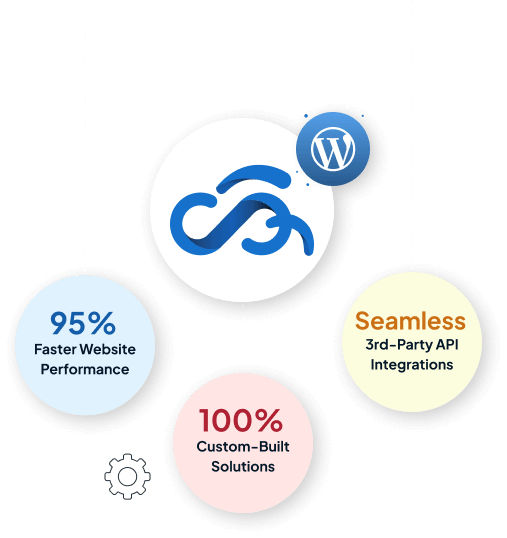
Why choose Cloud Analogy for your next Java Development Services?
With a team of highly skilled experts and top-notch services, businesses trust us as their Java Development Partner for thousands of reasons. Here’s why:
- Delivered scalable, secure Java apps for FinTech, Automotive, Retail, and Pharma.
- Expert in the latest Java frameworks for high-performance, cloud-native solutions.
- Specialized in enterprise apps, web platforms, and mobile apps tailored to business needs.
- Skilled in scalable, portable Java apps with seamless cloud integration.
- Expertise in cutting-edge integration patterns for enhanced functionality.
- Agile methods ensure faster delivery and continuous updates.
- End-to-end support for smooth operations and maximum uptime.
- Dedicated team delivering tailored solutions for business success.
Projects Delivered Globally
Satisfied Clients
Experts
Years of Excellence
What sets us apart?
Guaranteed On-Time Delivery
High-Quality Solution Development
Flexible, No Lock-In Engagement Model
Security and Scalability
Extensive & Proven Industry Expertise
Dedicated and Responsive Customer Support
We Provide Java Development Services
Experience scalable, flexible cloud-based Java app development with robust infrastructure for quick deployment and lower costs. Discover how our solutions can revolutionize your business—contact us today!
Java Software Development Services
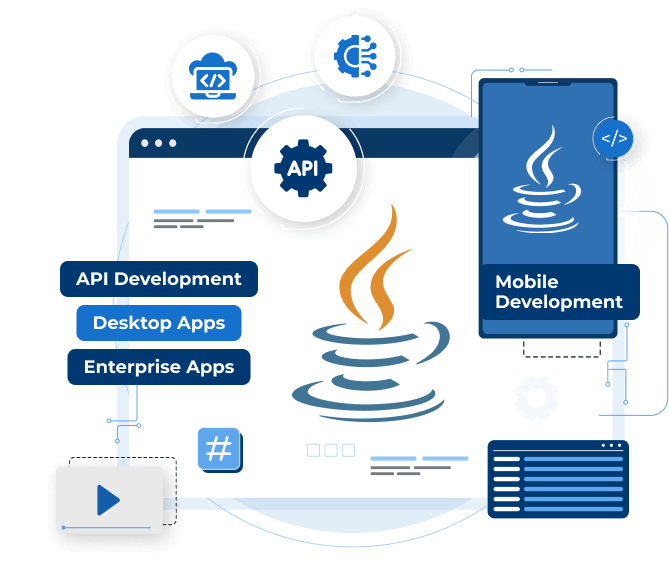
As a Java development company, we provide advanced Java software development services, crafting robust, scalable, and secure applications tailored to your business needs. Our expert team delivers customized solutions that drive growth and success.
Enterprise Application
Our Enterprise Application services deliver customized software solutions tailored to your business needs. We analyze requirements to create applications that streamline operations, enhance productivity, and increase profitability.
Java Web Development Services
Our Java engineers excel in web architecture and ecosystem, using the Spring framework and advanced methodologies for robust solutions. We deliver cutting-edge Java web development with optimal multi-threading, UI design, and resource management.
Java Mobile App Development Services

Our seasoned Java developers specialize in crafting fast, intuitive, and feature-rich mobile applications. We deliver multi-tiered enterprise solutions, cross-platform apps, and seamless integration using REST, XML-RPC, SOAP, and more.
Java Integration Services
Our team ensures smooth integration and migration of your business applications to Java, handling data migration complexities with strict quality standards. We offer expert Java app development and migration services for a smooth transition.
Java Cloud Development Services

We specialize in building microservice architectures with Spring Boot and configuring cloud-based applications using Spring Cloud. Our solutions, hosted on platforms like Azure, AWS, and OVH, ensure ideal performance and scalability for your projects.
Cutting-edge Tech Stack - The Backbone of Our
Java Development Excellence

Providing Digital Solutions To Business Of Diverse Industries

Healthcare

Retail & Ecommerce

Travel & Tourism

Professional Business

Education

Media & Entertainment

Events

Food & Restaurants

Automotive

Fashion

Finance

Real Estate
Creating Agile Java Solutions
for Diverse Needs
01Consultation & Planning
Define scope, align goals, and create a detailed development plan

02Design & Development

Developing scalable, secure, and high-performance Java applications.
03Testing & Optimization
Rigorous testing, performance tuning, and security hardening.
04Launch & Deployment
Smooth and efficient deployment with minimal disruption.
05Ongoing Support
Continuous monitoring, proactive maintenance, and timely updates.
Get in Touch Now!
Talk to our expert to get a custom proposal & tailored guidance!
Sales Inquiry:
info@cloudanalogy.com
Cloud Analogy
HR Inquiry:
info@cloudanalogy.com
hr-cloudanalogy
An OTP is Sent to your provided Email ID
Please Check your Inbox and Spam/Junk folder
Frequently Asked Questions
Java's strong typing, mature ecosystem, and JVM-based performance make it the preferred choice for large-scale Enterprise Java Development where stability, long-term maintainability, and high concurrency are non-negotiable requirements. Python excels in data science and rapid prototyping but lacks Java's performance and type safety at enterprise scale. Node.js suits real-time, event-driven applications but struggles with CPU-intensive workloads where Java's multi-threading capabilities deliver consistent throughput. For mission-critical banking, insurance, healthcare, and logistics systems, Java remains the most reliable foundation.

A monolithic Java application packages all business logic into a single deployable unit, making it simpler to develop initially but harder to scale and maintain as the codebase grows. Java Software Development using a microservices architecture splits the application into independently deployable services that communicate through APIs, allowing individual components to scale, update, or fail without affecting the entire system. Transitioning from monolith to microservices requires careful domain decomposition, service boundary definition, and investment in inter-service communication and observability infrastructure before the benefits materialize.

Spring Boot removes the XML-heavy configuration burden of traditional Java EE development by providing auto-configuration, embedded server support, and production-ready health monitoring out of the box, allowing Java Developers to build and deploy REST APIs and microservices in a fraction of the setup time. Spring Cloud extends this further for distributed systems, handling service discovery, configuration management, and circuit breaking without custom infrastructure code. Teams using Spring Boot deliver working prototypes faster while maintaining the architectural discipline that large enterprise applications require.
Migrating a legacy Java application to cloud-native involves assessing the existing codebase for tight infrastructure dependencies, refactoring tightly coupled modules into independently deployable services, containerizing the application using Docker, and deploying to orchestration platforms like Kubernetes on AWS, Azure, or GCP. Attempting a full rewrite simultaneously with migration creates unacceptable delivery risk. A phased strangler pattern approach, where new cloud-native components progressively replace legacy modules while the system stays live, reduces migration risk significantly for large enterprise systems with active production traffic.
Security in Java Development Services encompasses input validation and output encoding to prevent injection attacks, secure session management, role-based access control using Spring Security, encrypted data storage and transmission, dependency vulnerability scanning using tools like OWASP Dependency Check, and regular penetration testing against the running application. Security cannot be added after development as an afterthought since architectural decisions made early in a project determine how difficult remediation becomes later. Building threat models and security requirements into the design phase is the most cost-effective approach.
Java's multi-threading model, combined with tools like the Java Concurrency utilities, reactive frameworks such as Spring WebFlux, and virtual threads introduced in modern Java versions, allows applications to handle thousands of simultaneous requests efficiently without the blocking behavior that degrades performance under heavy load. Concurrency bugs including race conditions and deadlocks are among the most difficult production issues to diagnose, making thread safety design and code review essential parts of any high-concurrency Java project rather than concerns addressed after performance problems emerge.
Java applications run well on major cloud platforms through containerized deployments on Kubernetes, serverless functions using AWS Lambda or Azure Functions with GraalVM native compilation to reduce cold start times, and managed database services that eliminate infrastructure management overhead. Java Development Services targeting cloud deployment use Spring Cloud or Micronaut frameworks that integrate natively with cloud service discovery, configuration management, and distributed tracing tools. Choosing between JVM-based and native-compiled deployment depends on the application's latency sensitivity and expected traffic patterns.
A focused microservice or API layer project takes 8 to 12 weeks from requirements to production deployment, while a full Enterprise Java Development platform covering multiple integrated modules, custom business logic layers, and cloud deployment pipelines typically takes 4 to 9 months. Timeline accuracy depends heavily on how clearly requirements are defined before development begins and how stable they remain during delivery. Agile sprint cycles with weekly incremental deliverables provide more predictable progress visibility than waterfall approaches for complex Java projects.
Long-term Java application maintenance requires a structured dependency upgrade cycle to stay current on security patches, periodic Java version migrations to maintain LTS support and access to modern language features, test coverage that validates behavior across upgrades before production deployment, and code quality monitoring through static analysis tools that catch regressions early. Java Software Development projects that accumulate technical debt through skipped upgrades and absent test coverage become exponentially more expensive to maintain as the gap between the application's Java version and the current LTS release widens over time.