NodeJS Development Services
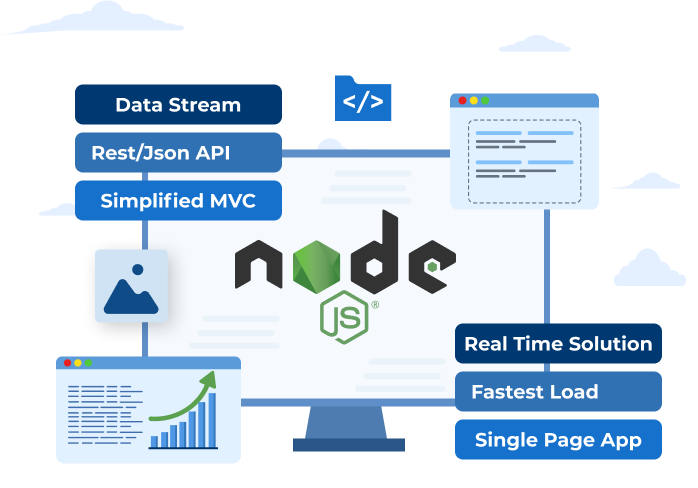
NodeJS Solutions: Fast, Scalable,
Future-Ready
We stand out as your ideal partner for Node.js app development. We deliver high-quality, scalable applications tailored to your business needs and offer exceptional support and expertise.
Explore our NodeJS App
Development Services:

API Development

UI/ UX Designing

Backend Development

Custom Plug-in
Why choose Us?
Choose us for scalable, high-quality Node.js solutions tailored to your needs, delivered rapidly with comprehensive support.
- Expertise in Scalability: We build scalable applications that handle high traffic efficiently. Your project can grow with your business.
- Quality Development: We deliver robust applications using Node.js’s event-driven architecture. This enhances performance and user experience.
- Tailored Solutions: We provide customized development services. Our solutions align with your specific requirements and business objectives.
- Rapid Delivery: We commit to timely project completion. Your applications are delivered on schedule without compromising quality.
- Comprehensive Support: We offer dedicated post-launch support. Our team provides ongoing maintenance and updates to keep your application running smoothly.
Projects Delivered Globally
Satisfied Clients
Experts
Years of Excellence
What sets us apart?
Guaranteed On-Time Delivery
Development of High-Quality Solutions
Flexible Engagement Model with No Lock-In
Focus on Security and Scalability
Proven Expertise Across Various Industries
Dedicated and Responsive Customer Support
WE Provide
NodeJS Development Services

Web Development
Develop robust web applications with real-time features, ideal for projects with heavy user interaction and top-notch scaling capabilities.
Mobile Application Development
Create lightweight, feature-rich, and performant cross-platform mobile apps leveraging JavaScript advantages for speed and scalability.
Backend Development
Maximize application potential with efficient Node.js backends, capable of managing massive traffic and request volumes.
API Development
Achieve seamless and secure API development with Node.js, enabling smooth real-time interactions for diverse data formats.
Plugin Development

Build modular, customizable, and maintainable applications with robust plugins developed using the Node.js technology stack for easy scaling.
Your Node.js Development Company:
Building a Future-Proof Business
Providing Digital Solutions To Businesses Of
Diverse Industries

Healthcare

Retail & Ecommerce

Travel & Tourism

Professional Business

Education

Media & Entertainment

Events

Food & Restaurants

Automotive

Fashion

Finance

Real Estate

Transforming Ideas into Scalable
Node.js Solutions
01Consultation & Planning
Define project scope, align with business objectives, and create a development plan.
02Design & Development
Developing scalable, secure, and high-performance Java applications.
03Testing & Optimization
Rigorous testing, performance tuning, and security hardening.
04Launch & Deployment
Smooth and efficient deployment with minimal disruption.
05Ongoing Support
Continuous monitoring, proactive maintenance, and timely updates.
Get in Touch Now!
Talk to our expert to get a custom proposal & tailored guidance!
Sales Inquiry:
info@cloudanalogy.com
Cloud Analogy
HR Inquiry:
info@cloudanalogy.com
hr-cloudanalogy
An OTP is Sent to your provided Email ID
Please Check your Inbox and Spam/Junk folder
Frequently Asked Questions
Node.js uses a non-blocking, event-driven architecture that processes multiple simultaneous requests on a single thread without waiting for one to complete before starting another, unlike traditional multi-threaded servers where each request occupies a thread until resolved. Node.js Web Development architectures excel in scenarios involving heavy I/O operations such as API calls, file reads, and database queries because the event loop keeps processing other requests while waiting for those operations to complete rather than sitting idle.
Node.js delivers faster development cycles and lower resource overhead for I/O-bound API backends compared to Java's multi-threaded model, while Python offers a richer data science and machine learning library ecosystem that Node.js cannot match. Node.js Development Services are the strongest choice for real-time applications, streaming platforms, and API gateways where request throughput and low latency matter most. Python and Java remain better options for CPU-intensive data processing, AI integration, or enterprise applications requiring strict type enforcement at compile time.
Node.js Developers implement real-time features using WebSockets through the Socket.io library or native WebSocket API, maintaining persistent bidirectional connections between the server and client so data updates push instantly without the client polling the server repeatedly. This makes Node.js the dominant choice for live chat, multiplayer game backends, collaborative editing tools, and real-time analytics dashboards. Event-based architecture also makes it straightforward to broadcast the same update to thousands of connected clients simultaneously with minimal server overhead.
Node.js is single-threaded by design and performs poorly on CPU-heavy tasks like image processing, video encoding, or complex data computation when handled directly in the main thread, because these operations block the event loop and prevent other requests from being processed. Custom Node.js Development teams handle this through Worker Threads for parallel CPU work within the same process, offloading intensive tasks to separate microservices built in more CPU-optimized languages, or using background job queues through Bull or BullMQ to process heavy tasks independently.
Large Node.js Web Development backends stay maintainable through a layered architecture separating route definitions, controller logic, service layer business rules, and data access repositories into distinct modules rather than mixing all logic inside route handlers. Dependency injection patterns keep modules loosely coupled and individually testable. TypeScript adoption adds compile-time type safety that catches structural errors before runtime, which becomes increasingly valuable as the codebase grows and multiple developers work across the same backend simultaneously.
A Custom Node.js Development project for a REST API backend with authentication, database integration, third-party service connections, and deployment configuration typically takes 6 to 10 weeks from requirements to production. Microservices architectures involving multiple independent services, message queues, and distributed tracing infrastructure take 3 to 5 months depending on the number of services and the complexity of inter-service communication patterns. Clearly defined API contracts between frontend and backend teams before development begins consistently reduces rework and timeline overruns on Node.js projects.
Node.js Development Services security practices include rate limiting incoming requests to prevent abuse using libraries like express-rate-limit, input validation and sanitization through Joi or Zod schemas before data reaches business logic, JWT or OAuth 2.0 token validation on protected routes, SQL injection prevention through parameterized queries rather than string concatenation, and regular dependency auditing using npm audit to catch known vulnerabilities in third-party packages. HTTPS enforcement and security header configuration through Helmet are baseline requirements that should be applied to every Node.js API before production deployment.
Node.js is particularly well-suited for microservices because its lightweight runtime starts quickly, consumes low memory per instance, and handles the high volume of inter-service API calls that microservices architectures generate. Individual services are containerized using Docker and orchestrated through Kubernetes, with service-to-service communication handled through REST APIs, gRPC for low-latency internal calls, or message brokers like RabbitMQ and Kafka for asynchronous event-driven workflows. A Node.js Development Company building microservices should define service boundaries and API contracts before any individual service is built.
A capable Node.js Development Company should demonstrate hands-on experience with production API architecture, real-time application development, microservices design, and containerized deployment rather than just basic Express.js familiarity. Ask about their approach to security hardening, database query optimization, error handling, and TypeScript adoption for larger projects. Reviewing the performance benchmarks and architectural decisions of past projects gives a more reliable signal of capability than portfolio screenshots, since Node.js projects that look functional can still carry significant technical debt in error handling and concurrency management.