
ServiceNow
ServiceNow Consulting Services for Enterprise Transformation
Empower your business with expert ServiceNow consulting, implementation, integration, automation and optimization services designed to streamline operations, improve workflows and maximize your ServiceNow investment.
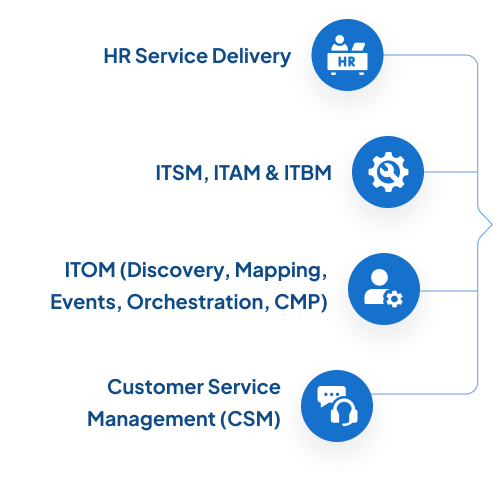
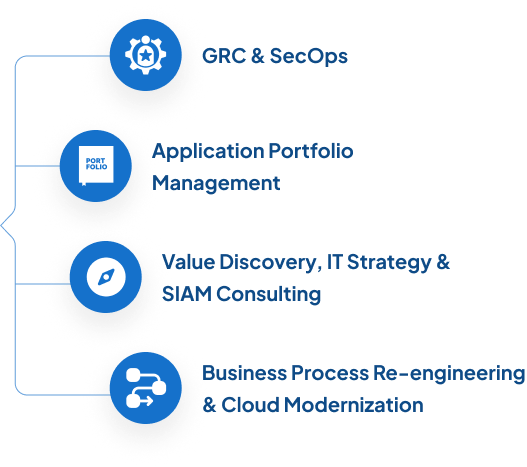
ServiceNow Core Capabilities We Excel At

Trusted ServiceNow Experts Across Every Industry
- Automative
- Banking
- Consumer Packaged Goods
- Healthcare
- Insurance
- Life Sciences
- Manufacturing
- Nonprofit
- National Government
- Retail
- Technology Providers
- Telecom
What We Offer
A complete suite of consulting and delivery services to guide, optimize, and transform your digital operations.
IT Consulting & Integration
IT strategy, portfolio optimization, value realization, SIAM, operating model setup, and M&A consulting.
API Management, Business Analysis & AI
Legacy-to-modern integrations, iPaaS enablement, API lifecycle management, and enterprise integration strategy.
Program Management & PMO Services
PMO setup, governance, program advisory, assessments, and organization change management.
IT Governance & Platform Services
IRoadmapping, platform provisioning, ServiceNow implementation, process design, and platform upgrades.
ServiceNow Key Offerings
Unlock the full potential of ServiceNow with tailored solutions across the platform lifecycle.
Platform Provisioning
Efficient license procurement, renewals, and module recommendations aligned with your business needs.
Strategic Roadmap Advisory
Collaborative phase-wise planning to maximize ROI and drive seamless platform adoption.
Process Design & Implementation
End-to-end process discovery, optimization, and digitization using industry-aligned ServiceNow best practices.
Upgrade Services
Smooth platform upgrades supported by automated regression testing and long-term release strategies.
Enhancement & Support
Comprehensive L1–L3 support, administration, enhancements, and DevOps-driven continuous improvements.
Our ServiceNow Implementation Phases
A proven, outcome-driven methodology ensuring seamless delivery and long-term platform success.


Initiate
Define vision, scope, governance, stakeholders, and project setup, concluding a formal kickoff.


Plan & Prepare
Conduct workshops, analyze processes, gather user stories, design architecture, and finalize timelines.


Execute & Create
Configure the platform in Agile sprints, build features, validate continuously, and prioritize OOTB solutions.


Deliver & Transition
Perform system testing, UAT, training, documentation, and prepare for a stable go live.

Close
Provide hyper care support, gather feedback, measure outcomes, and ensure smooth operational handover.
Why Choose Cloud Analogy As Your ServiceNow Consulting Partner
Deep Platform Expertise
Mastery across all ServiceNow modules and enterprise workflows.
Enhanced ROI Delivery
Solutions engineered to maximize value, efficiency, and cost savings.
Trusted & Transparent Partnership
Reliable collaboration with consistent communication and shared ownership.
Proven Implementation Methodology
Structured frameworks ensuring timely, high-quality, and scalable outcomes.
Commitment to Customer Success
Relentless focus on delivering transformative, result-driven solutions.
Certified Expert Team
A skilled crew of certified architects, developers, and consultants.
Our Work
ServiceNow AI seamlessly powers enhanced operations across customer service, IT, HR, security, and business workflows—delivering measurable impact across industries.


Let’s Build a Smarter, Faster, Connected Enterprise
Drive operational excellence with ServiceNow-powered automation, intelligent workflows and expert consulting services tailored to your business needs.
Frequently Asked Questions
ServiceNow consulting services help businesses plan, implement, improve, and manage their ServiceNow environment. This can include platform assessments, process design, ITSM and ITOM implementation, integrations, workflow automation, upgrades, and ongoing optimization. A good consulting partner looks at how your teams actually work and then uses ServiceNow to simplify those processes rather than simply recreating existing systems on a new platform.
Cloud Analogy provides ServiceNow consulting services covering strategy, implementation, integration, process improvement, automation, upgrades, and ongoing support. We can help assess your existing ServiceNow environment, identify improvement opportunities, define a practical roadmap, configure workflows, connect ServiceNow with other business systems, and support the platform as your requirements evolve.
Look for a ServiceNow consulting company with relevant platform expertise, certified professionals, experience with projects similar to yours, strong integration capabilities, and a clear implementation approach. It is also worth asking about post-go-live support, upgrade experience, and examples of measurable results. Case studies and references can tell you much more about a partner's practical experience than a list of services alone.
A ServiceNow ITSM implementation can take anywhere from several weeks to several months, depending on the scope of the project. The timeline is usually affected by the number of processes being implemented, integrations, data migration, customization, testing, and user readiness. A well-defined discovery and planning phase helps establish a realistic timeline before configuration and implementation begin.
A typical migration starts with understanding the existing ITSM processes, data, integrations, and reporting requirements. The next steps usually include solution design, data mapping and migration, workflow configuration, integration development, testing, user acceptance testing, training, and deployment. Migration is also an opportunity to simplify outdated processes instead of carrying unnecessary complexity from a legacy platform into ServiceNow.
ServiceNow can integrate with third-party applications through APIs, integration frameworks, connectors, and workflow automation. The right approach depends on which systems need to exchange data, how frequently information must be synchronized, and the organization's security and architecture requirements. A consulting partner can help design the integration so that data moves reliably between systems without creating unnecessary manual work.
A ServiceNow consulting company can support a range of modules, including ITSM, ITOM, ITAM, CSM, HR Service Delivery, GRC, Security Operations, Discovery, and Service Mapping. The right combination depends on the organization's business priorities and existing ServiceNow environment. Many organizations start with a specific business need, such as IT service management, and then expand the platform as additional use cases are identified.
A ServiceNow upgrade should be planned well before changes are moved into a production environment. The process typically includes reviewing customizations, checking integrations, testing key workflows, performing regression testing, and completing user acceptance testing. Identifying compatibility issues early makes the upgrade more predictable and reduces the risk of unexpected problems after the new release goes live.
ServiceNow managed support can cover day-to-day administration, troubleshooting, incident and problem resolution, enhancements, integrations, workflow changes, performance improvements, and upgrade assistance. The exact support model depends on the organization's needs and may include L1, L2, and L3 support. Ongoing support can also help teams continuously improve their ServiceNow environment instead of treating the platform as a one-time implementation.
An effective ServiceNow consulting service starts with understanding the business problem, not just configuring the platform. The consulting team should be able to translate business requirements into practical workflows, integrations, and ServiceNow solutions while avoiding unnecessary customization. Clear planning, strong technical expertise, good communication, user adoption, and ongoing optimization all contribute to a ServiceNow implementation that delivers lasting business value.