
Salesforce Experience Cloud Services
Salesforce Experience Cloud Services
Transforming how organizations engage with their customers, partners, & members with our Salesforce Experience Cloud Services
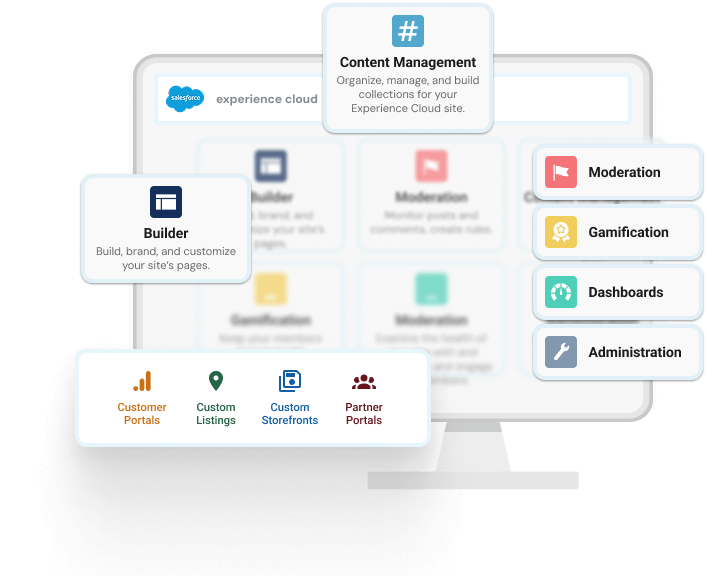
Globally Trusted for Delivering High-Impact Salesforce ROI






Types of Salesforce Communities We Are Experts At
With Salesforce Experience Cloud, you get pre-built, customizable templates that cover all aspects of your business and sales cycles.
Our experts specialize in delivering connected experiences and customer 360 solutions with Salesforce Experience Cloud.
Customer Communities
Engage and connect with your customers by creating a dedicated community where they can access support and resources and collaborate.

Partner Communities
Empower your partners with a platform to access sales and marketing materials, collaborate on deals, and streamline joint business processes.

Employee Communities
Enhance employee engagement and productivity by creating a community to access company resources, communicate, and collaborate.

Boost Collaboration & Engagement Using
Salesforce Experience Cloud Key Features
Build engaging portals &
communities in no time
Empower customers with easy
account management
Enhance self-service with
Integrated CRM Data
Tap into customer expertise
for active engagement
Deliver personalized and
intelligent self-service
Our Best-In-Class Salesforce Community Cloud Services
Salesforce Community Cloud Consultation Services
Get expert guidance from our Salesforce consultants to define your community goals & select the right features for success.
Salesforce Community Cloud Designing Services
Drive higher engagement with user-friendly designs and intuitive features that enhance collaboration.
Salesforce Community Cloud Customization Services
Tailor the Community Cloud to your business needs, ensuring it aligns perfectly with your future growth and objectives.
Salesforce Community Cloud Implementation Services
We design, customize, and implement Salesforce Community Cloud for seamless collaboration, branding, and user engagement.
Salesforce Community Cloud Integration Services
Seamlessly integrate your digital community with existing processes, ensuring a smooth and seamless user experience.
Salesforce Community Cloud Support Services
Keep your community thriving with our dedicated assistance and frequent updates, ensuring the continued community’s success.
Our Success Stories

Want to get started with
Salesforce Experience Cloud?
Take you customer support to the highest level with the top Salesforce service cloud solutions.

Frequently Asked Questions
Customer communities give external customers self-service access to support, account information, and resources, partner communities give channel partners tools to manage deals, access sales materials, and collaborate on joint opportunities, and employee communities give internal staff a hub for company resources and cross-team communication. Each type uses different templates, permission structures, and branding needs.
Experience Cloud Implementation typically takes 6 to 12 weeks depending on the type of community being built, the number of custom components required, and how much CRM data needs to be exposed through the portal. Partner portals with deal registration and complex sharing rules generally take longer than simple customer self-service sites.
Customer Portal Development on Experience Cloud connects directly to the same case, order, and account data living in the core Salesforce org, so customers see real-time status updates without staff manually relaying information through email or phone calls. This typically involves configuring sharing rules so customers see only their own records, building self-service case submission forms, and surfacing relevant knowledge articles.
Yes, Partner Portal Solutions built on Experience Cloud give partners a dedicated space to register deals, access marketing and sales collateral, track commission or rebate status, and collaborate with the core sales team on joint opportunities, all tied to live CRM data rather than static shared folders. This reduces the manual back-and-forth that slows down partner-led sales cycles.
Cloud Analogy is a Salesforce Summit Partner with dedicated experience delivering Salesforce Experience Cloud Consulting Services across customer, partner, and employee community types. Our team handles the complete project lifecycle from discovery and branding design through build, CRM integration, and post-launch support, ensuring each community is built around the actual workflows its users need rather than a generic template. We focus on measurable outcomes like case deflection, partner engagement, and adoption rates rather than just delivering a portal and walking away.
Experience Cloud is simply the renamed and expanded version of what Salesforce previously called Community Cloud, with the underlying platform capabilities for customer, partner, and employee portals remaining largely the same under the new name. Organizations searching for a Community Cloud Consultant are typically looking for the same Experience Cloud expertise, since Salesforce rebranded the product rather than replacing it. Cloud Analogy's team has experience spanning both eras of the platform and its naming history.
Experience Cloud pulls directly from the same Salesforce data model used by internal teams, meaning self-service features like order tracking, knowledge article search, and case submission reflect real-time, accurate information rather than a separate, disconnected dataset that needs manual syncing. This tight integration is what distinguishes Experience Cloud from a standalone portal product bolted onto a CRM.
Yes, organizations can run multiple Experience Cloud sites from a single org, such as a separate customer community, partner community, and employee community, each with its own branding, permissions, and components while still drawing from shared underlying CRM data. This is common for businesses managing distinct relationships with customers, resellers, and internal staff that each need different access and functionality.
Key adoption metrics include active login rates, self-service case deflection percentage, content engagement on knowledge articles, and time-to-resolution for cases submitted through the portal compared to traditional channels. Low adoption is often traced back to poor findability, an unclear navigation structure, or a portal that doesn't actually solve the problems users come to it for.