MULESOFT DEVELOPMENT SERVICES
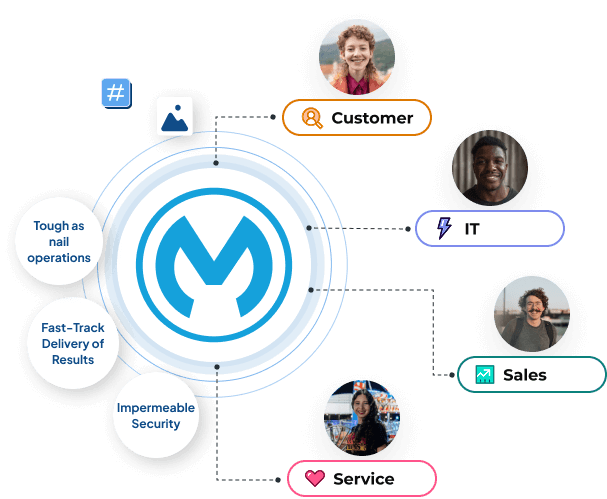
Transform your integrations with MuleSoft:
Connect anything, change everything!
Cloud Analogy delivers expert MuleSoft development services, ensuring smooth data synchronization and robust API management to enhance your business processes and drive innovation.
Key Offerings in Our MuleSoft
Development Services

MuleSoft Migration Services
- Legacy ESB migration and platform upgrades
- Risk mitigation and business continuity assurance
- Custom connectors with rapid deployment accelerators

API Design & Development
- Creation of RESTful APIs using RAML/OpenAPI
- Reusable, scalable, and secure API development
- Implementation of MuleSoft’s API lifecycle management

MuleSoft Anypoint Platform Implementation
- Full setup and configuration of Anypoint Platform
- CloudHub and on-premises deployments
- Role-based access and governance setup

System Integration Services
- Seamless integration with Salesforce, SAP, Oracle, Workday, and more
- Real-time and batch data integration
- Legacy system modernization through APIs

Managed Services & Support
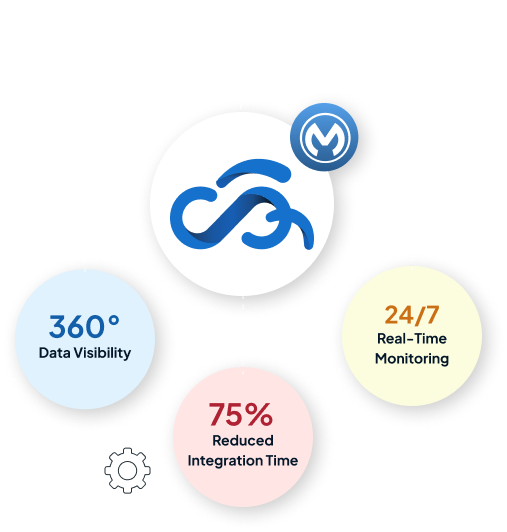
- 24/7 monitoring and proactive maintenance
- Performance tuning and health checks
- Bug fixes, patching, and upgrades

MuleSoft Consulting & Strategy
- Assessment of current systems and integration needs
- API-led connectivity strategy design
- Roadmap planning for digital transformation
How Does Cloud Analogy Transform Your Business Through MuleSoft Development Services?
We provide top-tier MuleSoft development services, specializing in API design, management, and integration. Our certified developers build custom APIs using MuleSoft’s Anypoint Platform to unlock your data and drive business agility.
- Efficient, tailored integration for your business.
- Scalable, secure MuleSoft solutions for industries.
- Leveraging Anypoint Platform for API builds.
- Dynamic integration platforms, feature-rich MuleSoft APIs.
- Scalable MuleSoft apps with cloud integration.
- Integrating systems with MuleSoft Anypoint Platform.
- Rapid MuleSoft development, agile delivery.
- End-to-end support for seamless operations.
- Tailored MuleSoft solutions drive business growth.
Projects Delivered Globally
Satisfied Clients
Experts
Years of Excellence
What sets us apart?
Timely Delivery
Assurance
Top-Quality Solution Development
Flexible Engagement Model with No Lock-In
Robust Security and Scalability
Broad and Proven Industry Expertise
Committed & Responsive Customer Support
Design,
Development,
CRM,
Cloud
Why choose Cloud Analogy
for MuleSoft Development Services
Drive innovation with MuleSoft development services from Cloud Analogy. We connect your systems and data, creating agile, scalable solutions for rapid deployment and optimized efficiency. Contact us today and empower your business with seamless integration!
Accelerate Process Automation
We utilize MuleSoft's pre-built APIs and integration templates to streamline your workflows. We help you adapt and automate processes quickly, improving efficiency and reducing manual effort.
Omnichannel Customer Experiences
We connect data across all channels with MuleSoft, delivering more value to your clients. We create unified, seamless experiences that enhance customer satisfaction and drive loyalty.
Seamless SOA And Integration Services
Cloud Analogy's certified MuleSoft experts help you define, deploy, and measure the best service-oriented architecture strategy. We smoothly integrate your systems and also provide Anypoint Platform Development.
Process Analytics And Complex Event Processing
Cloud Analogy builds real-time visibility into your management systems with MuleSoft, enabling better predictions and pre-emptive action. We provide sophisticated analytics to optimize processes and improve decision-making.
Application Network Optimization
Cloud Analogy's experienced MuleSoft developers help you achieve secure, reusable integrations and APIs. We optimize your application network for enhanced performance and agility.
Proven Integration Knowledge
We offer out-of-the-box MuleSoft Consulting Services, driving process automation, efficiency, and consistency. Our expertise ensures successful MuleSoft implementations tailored to your unique business needs.
Frictionless Connectivity
We identify the best-advanced MuleSoft API Management for unified, frictionless connectivity. We create seamless connections between your systems and applications, eliminating data silos and improving collaboration.
Center Of Excellence
Cloud Analogy's Digital Integration Strategic Framework helps you leverage MuleSoft's connectivity and APIs to transform and disrupt with scale and agility. We provide a structured approach to MuleSoft ESB Development, ensuring long-term success and innovation.
Advanced MuleSoft Development Services: Driven by Innovation, Powered by Technology
Driving Success With Digital Solutions
For Every Industry

Healthcare

Retail & Ecommerce

Travel & Tourism

Professional Business

Education

Media & Entertainment

Events

Food & Restaurants

Automotive

Fashion

Finance

Real Estate
API-led connectivity
Integrate systems and data with MuleSoft
01Consultation & Planning
Exchanging ideas, understanding your goals, and drafting a strategic roadmap.
02Design & Development
Building user-friendly, responsive, high-performing WordPress websites.
03Testing & Optimization
Ensuring seamless user experience, website performance, and security checks.
04Launch & Deployment
Seamlessly go live with no downtime.
05Ongoing Support
Constant updates, safety upgrades, and performance improvements.
Get in Touch Now!
Talk to our expert to get a custom proposal & tailored guidance!
Sales Inquiry:
info@cloudanalogy.com
Cloud Analogy
HR Inquiry:
info@cloudanalogy.com
hr-cloudanalogy
An OTP is Sent to your provided Email ID
Please Check your Inbox and Spam/Junk folder
Frequently Asked Questions
Traditional point-to-point integration connects systems directly in pairs, creating a tangled web of dependencies that becomes expensive to maintain as the number of systems grows. MuleSoft Integration Services built on API-led connectivity instead organize integrations into three reusable layers: system APIs that unlock backend data, process APIs that orchestrate business logic, and experience APIs that deliver data to end consumers. This layered approach makes integrations reusable, easier to govern, and faster to update when individual systems change.
Simple single-system integrations can be completed in 3 to 6 weeks, while enterprise-level projects connecting multiple platforms such as Salesforce, SAP, Oracle, and Workday simultaneously typically take 3 to 6 months depending on data complexity, transformation requirements, and security design. Projects that also involve migrating from a legacy ESB to MuleSoft's Anypoint Platform take longer due to the discovery and mapping work required before development begins. A scoping assessment upfront produces a more accurate timeline based on the actual integration landscape.
Yes, MuleSoft Development Services support hybrid integration scenarios where on-premises systems and cloud platforms are connected in the same flow using Anypoint Platform's runtime fabric and on-premises runtime capabilities. This is common for businesses running legacy ERP systems on-premises while adopting cloud CRM, HRIS, or ecommerce platforms simultaneously. The Anypoint Platform manages both deployment models through a single unified control plane, giving operations teams consistent visibility regardless of where each runtime is hosted.
MuleSoft uses DataWeave, its built-in transformation language, to convert data between formats such as JSON, XML, CSV, and flat files within the same integration flow, without requiring separate ETL tools. Error handling is managed through exception strategies built into each Mule flow, defining what happens when a system is unavailable, a transformation fails, or a message doesn't match expected schema. Proper error strategy design is critical to building integrations that recover gracefully rather than silently dropping data.
MuleSoft API Development follows versioning practices where new API versions are deployed alongside existing ones, with routing policies in API Manager directing consumers to the appropriate version based on request headers or URI paths. This allows teams to release updated APIs without forcing all consumers to migrate simultaneously. Deprecation timelines are communicated through the Anypoint Exchange developer portal, giving internal and external consumers time to update their integrations before older versions are retired.
Anypoint Platform provides centralized API governance through API Manager, where policies covering rate limiting, authentication, IP allowlisting, and SLA enforcement are applied consistently across all APIs without requiring each development team to implement security individually. Access controls define who can publish, modify, or consume APIs, and Anypoint Exchange serves as an internal marketplace where reusable assets are discovered and reused rather than rebuilt. This governance structure is what separates a well-run integration program from a collection of one-off integrations.
Legacy ESB migration to MuleSoft starts with a discovery phase that catalogs all existing integration flows, message transformations, and routing rules before any new development begins. Flows are then rebuilt on the Anypoint Platform in priority order, typically starting with high-volume or high-risk integrations first. MuleSoft Consulting Services during migration focus heavily on avoiding a lift-and-shift approach, which simply recreates old problems on new infrastructure, in favor of redesigning integrations using API-led patterns that deliver long-term maintainability.
Yes, Anypoint Monitoring provides real-time visibility into API performance metrics, message throughput, error rates, and latency across all running integrations without requiring system restarts or deployments. Anypoint Visualizer maps the dependencies between integrated systems live, making it easier to trace where a failure originated across a complex integration network. Setting up alerting thresholds and dashboards during the initial implementation ensures operations teams are notified of anomalies before they affect downstream business processes.
MuleSoft Developers apply security at multiple layers, including OAuth 2.0 and JWT token validation at the API gateway level, TLS encryption for data in transit, client ID enforcement to control which applications can call each API, and field-level masking to prevent sensitive data from appearing in logs. Security policies are applied centrally through API Manager rather than embedded in individual integration flows, making them easier to update consistently across all APIs when requirements change.